
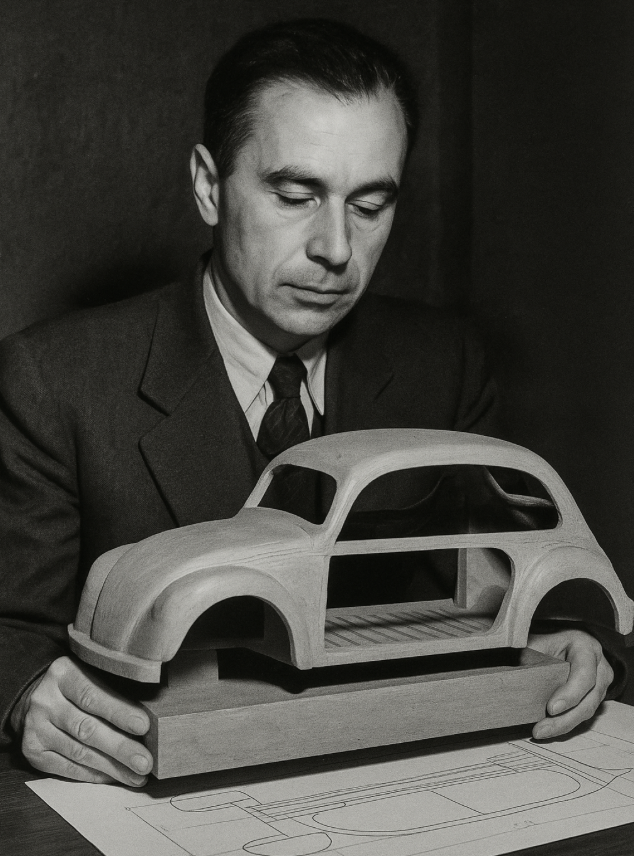
In 1939, a 32-year-old Austrian engineer walked into a job interview at Daimler-Benz. When asked what he would improve about the current Mercedes-Benz lineup, he answered boldly: “Pretty much everything.”
His name was Béla Barényi, and that audacity would save millions of lives.
An engineer who dared to question everything
Barényi’s life was anything but smooth. Born in 1907 near Vienna into a once-wealthy family, he lost his father in World War I and watched his grandfather’s industrial empire collapse. A childhood illness left him with a permanent physical disability. He dropped out of school, picked himself back up, studied engineering in Vienna, and drifted through several automotive companies before landing at Daimler-Benz.
Once there, he was given an unusual mandate: think 15 to 20 years ahead. His boss, Wilhelm Haspel, told him: “Whatever you invent will go directly to the patent department.” Barényi ran the pre-development department for the next 33 years and amassed over 2,500 patents — more than twice as many as Thomas Edison.
The revolutionary idea: rigidity kills
Before Barényi, automotive engineers operated under a simple assumption: a safer car is a stronger car. Make the body rigid, and passengers survive. It seemed logical. It was also dead wrong.
Barényi was the first to understand that in a collision, kinetic energy doesn’t simply disappear. If the car body is rigid, that energy transfers directly to the passengers. He proposed something counterintuitive: divide the car into three zones. A rigid passenger cell in the middle, protected by deliberately soft front and rear sections designed to deform on impact — absorbing the crash energy before it reaches the occupants.
He patented this concept in 1952. In 1959, the Mercedes-Benz W111 became the first production car with an integrated safety body. The first crash test confirmed what Barényi had calculated on paper years earlier — the crumple zones worked exactly as designed.
Today, every car on the planet uses this principle. A 1993 Mercedes ad said it simply: “No one in the world has given more thought to car safety than this man.”
From steel to software
Here’s what most people in tech don’t realize: this idea didn’t stay in the automotive world.
James R. Chiles, in his book Inviting Disaster: Lessons From the Edge of Technology, studied over fifty catastrophic failures — from Chernobyl to the Challenger — and identified a common thread: systems fail when cracks propagate unchecked through tightly coupled components. He called the protective mechanisms that stop these cascading failures “crackstoppers.”
Michael T. Nygard picked up this thread in his seminal Release It! Design and Deploy Production-Ready Software and made the connection explicit. Just as automotive engineers create crumple zones — areas designed to protect passengers by failing first — software architects can create safe failure modes that contain the damage and protect the rest of the system.
Nygard’s key insight: if you don’t design your failure modes, you’ll get whatever unpredictable ones emerge on their own. He illustrates this with a real case of an airline whose entire reservation system collapsed because a single unhandled database exception cascaded through every connected service. No crumple zones. No crackstoppers. Total system failure.
What crumple zones look like in your architecture
If you run production systems, this isn’t abstract theory. Crumple zones are concrete design decisions:
Circuit breakers that trip when a downstream service fails, preventing cascade failures across your microservices mesh.
Bulkheads that isolate resource pools so one misbehaving integration point can’t drain the entire system’s thread pool or connection pool.
Timeouts and retry budgets that let a component fail fast rather than hang indefinitely, blocking everything upstream.
Graceful degradation paths where your system sheds non-critical functionality under load — serving cached content, disabling recommendations, skipping analytics — while keeping core transactions alive.
Blast radius containment through cell-based architecture, where failures in one cell don’t propagate to others.
Each of these is a crumple zone: a deliberate area of controlled failure that absorbs the impact and protects the critical core — your users’ experience, your data integrity, your business continuity.
The deeper lesson
Barényi’s breakthrough wasn’t just technical. It was philosophical. He challenged the dominant mental model of his industry — that strength equals safety — and replaced it with a more nuanced truth: resilience comes from knowing where and how to yield.
The same paradigm shift is still underway in software. Too many teams build systems that are “strong” — tightly coupled, highly optimized for the happy path, with no planned failure modes. And then they’re surprised when a single database hiccup at 3 AM takes down everything.
Béla Barényi taught us that the safest systems aren’t the ones that never break. They’re the ones that break in the right places.
Design your crumple zones. Your 3 AM self will thank you.
References: Michael T. Nygard, “Release It! Design and Deploy Production-Ready Software” (Pragmatic Bookshelf); James R. Chiles, “Inviting Disaster: Lessons From the Edge of Technology” (Harper Business).